Sri Lanka Endemic Birds, A Field Guide to Finding Them in Sinharaja
For serious birdwatchers, Sri Lanka endemic birds in Sinharaja represent one of the greatest concentrated birding experiences on earth. Of the 35 endemic species recognised in Sri Lanka, 32 are found within the Sinharaja and Rakwana Hills complex, making this forest the single most important destination for anyone building a complete Sri Lanka endemic checklist.
I am Achi, a field naturalist, SLTDA-certified guide and tourist guides lecturer with nine years of daily observation in this forest. I hold a First Certificate in Ornithology from the University of Colombo and contribute verified bird records to eBird. This guide is built entirely from field experience, not from secondary sources. What I tell you about where, when and how to find these birds is what I have learned by walking these trails almost every day for nine years.
I want this guide to be genuinely useful to you. That means being honest about what you will realistically encounter, because Sinharaja’s birdlife, extraordinary as it is, depends on time, weather, season and which part of the forest you are in. A guide that promises guaranteed sightings is not telling you the truth. This one will.
How to Use This Sri lanka Endemic Birds Guide
I have organised Sri Lanka endemic birds into four groups based on how you are most likely to encounter them, not by taxonomy and not by an arbitrary rating that changes with every season.
Group 1, The Mixed Flock Species: Birds most reliably found when a mixed-species foraging flock is active. Finding the flock is everything here and that is where local knowledge matters most.
Group 2, Endemics: Species you are likely to encounter independently of the flocks, in the right habitat and time of day.
Group 3, Location and Habitat Specific: Species that require you to be in the right place, a specific entrance, elevation zone or microhabitat.
Group 4, Rare and Condition Dependent: Species that require patience, specific timing or genuine fieldcraft. These are the birds serious listers come back for.
The Mixed-Species Foraging Flocks, Sinharaja's Greatest Birding Phenomenon
Before the species accounts, I want to explain the mixed-species flock because understanding it will transform your experience in this forest.
Sinharaja is world-renowned for its mixed-species foraging flocks, locally known as bird waves. These are not casual gatherings. They are complex, structured movements of multiple endemic and resident species travelling together through the forest canopy in a coordinated feeding event. A full flock encounter in Sinharaja can involve anywhere from 15 to 48 species simultaneously, one of the largest mixed-species flock events recorded anywhere on earth.
Every flock is led by two endemic species. The Sri Lanka Drongo provides aerial vigilance, its alarm calls alerting the entire flock to predators. The Orange-billed Babbler moves through the understorey driving insects upward for the canopy species to intercept. Around these two leaders, dozens of other species assemble, each exploiting a different foraging niche within the same moving column of forest activity.
When a full flock passes through, the experience is overwhelming. Birds appear from every direction at once. The canopy erupts. You cannot process it all fast enough. I have watched this happen thousands of times and it still stops me completely.
The honest truth about finding flocks: they are most active between 6.30 and 9.00 in the morning. They follow loose territorial patterns that change with season and weather. Knowing which trails the resident flock groups use on a given morning and being there ahead of them is the difference between finding a flock and missing one entirely. This is local knowledge that no field guide can give you.
Group 1 — The Mixed Flock Species
These are the endemics most reliably encountered when a flock is active. On a good flock morning you may see most of these in a single two-hour window.
Sri Lanka Drongo (Dicrurus lophorinus) The dominant flock leader. Glossy black, fork-tailed and supremely alert. Perches at the flock’s leading edge, scanning for aerial predators while the rest of the assemblage feeds below. Its harsh alarm call scatters the entire flock in seconds. Present year-round and active throughout the day wherever flocks are moving.
Orange-billed Babbler (Argya rufescens) The flock’s other anchor species. A warm brown, long-tailed babbler that moves noisily through the forest understorey in family groups of seven to ten or more. Watch for them driving insects through the leaf litter and low vegetation. Loud, social and almost always present when a flock is forming. Their chattering is often the first signal that a flock is nearby.
Ashy-headed Laughingthrush (Argya cinereifrons) A vocal, social endemic of the forest interior that moves in tight groups through the mid-level vegetation. Grey-hooded with warm brown upperparts, a buff throat patch and a beady pale eye. Its calling and movement often signals that a flock is forming or active nearby.
Sri Lanka Scimitar Babbler (Pomatorhinus melanurus) A distinctive, long-billed babbler of the forest floor and dense understorey. Bold white eyebrow, deep chestnut upperparts and clean white underparts with a long, bright orange-yellow downcurved bill. Frequently present within mixed flocks, probing the leaf litter and fallen wood for invertebrates. Its loud duetting call is one of the defining sounds of the Sinharaja morning.
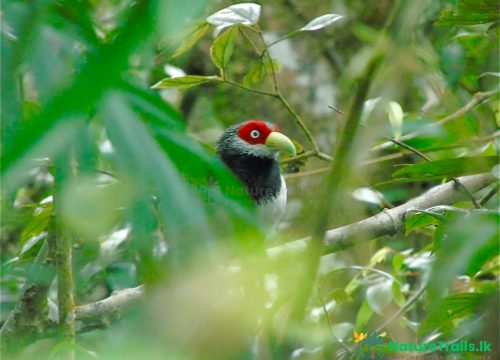
Red-faced Malkoha (Phaenicophaeus pyrrhocephalus) A large, elegantly built cuckoo with a vivid crimson facial patch that glows in the forest light. Dark green back, white belly and undertail with black barring, and a distinctive green bill. Moves through dense vegetation with surprising stealth for its size. Present in mixed flocks on some days and independent of them on others. Always a genuine highlight when it appears from the foliage.
White-faced Starling (Sturnornis albofrontatus) A scarce arboreal endemic with green-glossed dark grey upperparts, whitish underparts and a distinctive white face. Occasionally joins mixed flocks, particularly near fruiting trees. Classified as Vulnerable globally with an estimated population of 2,000 to 3,500 mature individuals distributed across fragmented wet zone forest. An encounter with this species should never be taken for granted.
Red-backed Flameback (Dinopium psarodes) A striking endemic woodpecker with a vivid crimson back and white underparts marked with bold black patterns. Males have a brilliant red crown while females have a black forecrown spotted with white. Joins mixed flocks opportunistically, working the bark of canopy trees for wood-boring invertebrates as the flock passes through. More often heard tapping before it is seen.
Crimson-backed Flameback (Chrysocolaptes stricklandi) A larger and more spectacular endemic woodpecker than the Red-backed, with deep crimson upperparts and black-scaled pale underparts. Males sport a red crest while females have a black crest with fine white markings. Unlike the Red-backed Flameback, it lacks a prominent white eyebrow. Typically found in pairs in the understorey of forests and often joins mixed-species flocks. Its rapid, high-pitched trill is distinctive once learned.
Yellow-fronted Barbet (Psilopogon flavifrons) A robust green barbet with a distinctive yellow forehead patch and blue patches below the eyes, on the throat and chin. One of the more conspicuous endemics, frequently encountered in the forest interior and along edges. Its repetitive, hollow call is one of the most characteristic sounds of Sinharaja throughout the day. Commonly seen perched in the mid-canopy at fruiting trees.
Group 2 — Endemics
These species are encountered independently of the mixed flocks, in appropriate habitat throughout the day.
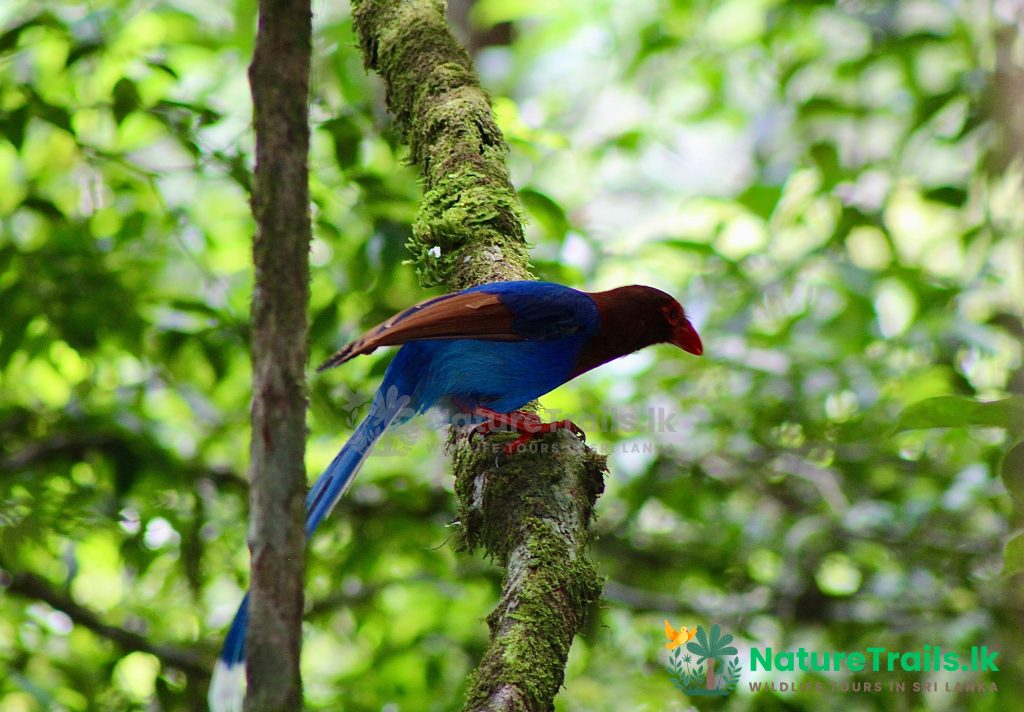
Sri Lanka Blue Magpie (Urocissa ornata) One of the most visually spectacular birds in Asia. Brilliant cobalt blue with rich chestnut wings, a reddish-brown head and neck, and a long graduated blue tail with a white tip. Both bill and legs are vivid red. Moves through the mid-canopy in small, vocal family groups. Most reliably and frequently encountered at the Kurulugala entrance where the transition zone between lowland and montane forest creates favourable conditions. Threatened globally and wholly dependent on intact forest. Sinharaja is its stronghold.
Spot-winged Thrush (Geokichla spiloptera) A ground-feeding endemic thrush, recognised by bold dark spots on the underparts, rows of white spots on the wings and black facial stripes below the eye. Often encountered directly on the forest trail at surprisingly close range when approached quietly. Presence is location and time dependent. Early morning before visitor numbers increase gives the best encounters.
Brown-capped Babbler (Pellorneum fuscocapillus) A small, brown, ground-feeding endemic with a dark brown crown and rich cinnamon underparts. Typically found on or near the ground in forests and forest edges, usually in pairs. Noisy for its size, its repetitive three-note whistle is a reliable indicator of its presence even when the bird itself remains hidden in dense vegetation.
Sri Lanka Hanging Parrot (Loriculus beryllinus) A tiny, brilliant green parrot barely larger than a sparrow, with a striking red crown and rump and an orange-tinted back. Fast-moving and easy to overlook unless you catch the flash of its red rump in flight. Less social than some relatives, often seen alone or in small groups. Its sharp, high-pitched whistled call carries above the forest noise and usually announces its presence before it is seen.
Sri Lanka Swallow (Cecropis hyperythra) An endemic swallow with deeply forked tail, chestnut underparts and rump with dark upperparts. Forages in the airspace above the forest canopy and along forest edges, typically in pairs or small groups. One of the more straightforward endemics to tick on any day in the right habitat.
Crimson-fronted Barbet (Psilopogon rubricapillus) A smaller endemic barbet, distinguishable from the Yellow-fronted Barbet by its crimson forehead and distinctive black crescent behind the eye. Often found foraging for fruit and insects in open wooded areas, gardens, forest edges and the forest interior in the lowlands and foothills. Its incessant, rapid popping call from treetops makes it one of the most easily located endemics on any tour.
Sri Lanka Grey Hornbill (Ocyceros gingalensis) Large, conspicuous and frequently encountered both inside the forest and in the surrounding buffer zone. Grey wings, a brown crown and a blackish tail with white sides. Often seen in pairs in the upper canopy, its loud accelerating laughing call carrying across the forest. One of the more reliable endemics for first-time visitors.
Sri Lanka Junglefowl (Gallus lafayettii) The national bird. Males are unmistakable with vivid orange and red plumage and a striking red comb marked with yellow on the crown. Regularly encountered along forest trails and at the forest edge in the early morning. Females are cryptically brown and easily overlooked. Heard as often as seen, with a distinctive harsh call quite different from the domestic chicken.
Sri Lanka Myna (Gracula ptilogenys) A medium-sized black starling with green-glossed, purple-tinged plumage. Commonly seen in small groups in forests and cultivated areas. Omnivorous and vocal, engaging in a variety of calls including a strident contact call. Nests in tree holes. A regular presence in and around the forest.
Sri Lanka Green Pigeon (Treron pompadora) A medium-sized green pigeon with a yellow face and yellowish line on the wing. Males have a distinctive maroon back. Typically found alone or in small groups at the upper levels of forests in lowlands and hills. Diet consists of seeds and fruits. Builds a stick nest in trees where it lays two white eggs.
Sri Lanka Wood Pigeon (Columba torringtoniae) A large, plain grey pigeon with conspicuous black-and-white stripes on the nape and mauve-flushed underparts. Found in the upper levels of forests and densely wooded areas, typically in pairs or small flocks. Its deep, owl-like double-note call is distinctive.
Black-capped Bulbul (Rubigula melanictera) A medium-sized bulbul with a jet black head, bright yellow underside and brownish eyes. Males have red irides while females have brown. Known for its sweet, mellow, minor-key piping whistles. Found in forests, open woodlands and gardens in the lowlands and foothills. Often seen in pairs or small groups, adding a bright flash of yellow to the forest understorey.
White-throated Flowerpecker (Dicaeum vincens) A small, stout songbird with dark upperparts and a white throat. Found in pairs within wet forests, feeding primarily on nectar and berries, making it an important part of the forest’s pollination ecology. High-pitched calls add to the background soundscape of a Sinharaja morning.
Layard’s Parakeet (Psittacula calthrapae) An endemic parakeet with bright green plumage, a bluish-grey head, a broad black chin stripe and a blue-tipped yellow tail. Males have a red-orange upper mandible while females have an all-black bill. Encountered in the mid-canopy near fruiting trees. Often detected by its loud, raucous call before it is located visually. Forms small groups that can be noisy and conspicuous when active.
Chestnut-backed Owlet (Glaucidium castanotum) A small, stocky endemic owl with distinctive chestnut brown upperparts and a pale belly with streaked flanks. Crepuscular and diurnal, often seen singly or in pairs in wet rainforest. Distinguishable from the similar Jungle Owlet by its chestnut back and streaked flanks. Its call is a series of barbet-like notes often followed by harsh yapping calls. Once common in wet zone forests, it is now found sparingly in remaining forest at altitude.
Group 3 — Location and Habitat Specific
These species require you to be in the right place. Entrance choice, elevation and specific microhabitat all matter.
Sri Lanka White-eye (Zosterops ceylonensis) A small, active endemic of the forest canopy with a bold white eye ring and yellow throat. Slightly larger than the Indian White-eye and lacks the yellow forehead. Most reliably encountered at the Kurulugala entrance and higher elevation zones within the Sinharaja complex. Sociable, forming active flocks that disperse during the breeding season.
Dull-blue Flycatcher (Eumyias sordidus) A montane endemic with mostly blue plumage, an intense blue forehead, a black face and a pale greyish belly with a distinctive black patch between the bill and the eye. Found in the dense wet forests of the hills and mountains. Most reliably encountered at the Kurulugala entrance within the Sinharaja complex. Feeds on flying insects, beetles, caterpillars and berries. During the breeding season in March and April, builds cup-shaped nests on shaded rock ledges.
Yellow-eared Bulbul (Pycnonotus penicillatus) An endemic bulbul with olive upperparts, yellowish underparts, a grey crown and distinctive yellow ear tufts with a patch below the eye. The least common of the bulbuls in Sri Lanka. Most consistently found at the Kurulugala entrance within the Sinharaja complex where the forest character shifts toward the conditions this species favours. Moves in small parties with a bouncing, woodpecker-like flight.
Sri Lanka Thrush (Zoothera imbricata) A secretive, ground-dwelling thrush with extensive black scaling covering the body and rich buff underparts. Long bill and a preference for the understorey of wet forests in lowlands and mountains. Commonly heard along forest tracks in the foothills but rarely seen except by observers who move very slowly and watch the forest floor carefully. Its mournful, unobtrusive song is a signature sound of its preferred habitat.
Sri Lanka Whistling Thrush (Myophonus blighi) A notoriously secretive endemic of dense forest near fast-moving streams. Males display dark blue plumage with vibrant blue shoulder patches while females are brown above and chestnut below with a blue shoulder patch. Primarily associated with higher elevations above 900 metres and most reliably encountered at the Kurulugala entrance within the Sinharaja complex. The call, a rich complex series of whistled notes, is heard far more often than the bird is seen. Due to habitat loss this species is declining and a clear sighting is a genuine prize for any serious birder.
Group 4 — Rare and Condition Dependent
These species require patience, specific timing or genuine fieldcraft. They are the birds serious listers come back to Sinharaja for.
Green-billed Coucal (Centropus chlororhynchos) Sri Lanka’s rarest endemic bird globally and the one most requested by serious birdwatchers visiting Sinharaja. A mid-sized cuckoo with black plumage and a purplish sheen, dark rufous wings and a distinctive pale greenish bill that distinguishes it immediately from the larger Greater Coucal. Confined to the wet zone lowlands below 800 metres. Beyond Sinharaja, also recorded at Kanneliya, Kitulgala, Morapitiya and Dombagaskanda, but Sinharaja remains its most reliable stronghold on earth. Its call is a series of deep, double notes resembling a stone dropping into water, a slow descending hollow sound that carries through the understorey. But hearing it and seeing it are very different things. The Green-billed Coucal is genuinely shy, moving through dense vegetation with remarkable stealth for its size. Every encounter should be treated as the privilege it is.
Sri Lanka Spurfowl (Galloperdix bicalcarata) Shy, terrestrial and detected by call far more often than by sight. Both male and female exhibit brown upperparts, wings and tail. Males stand out with vivid crimson red legs, bare facial skin and striking black and white dorsal plumage. Females have chestnut underparts and a plain brown back. Its rollicking, explosive call, a rising piping series, is one of the defining sounds of the Sinharaja dawn. But the bird itself remains hidden in dense undergrowth with remarkable effectiveness. Patience, stillness and an early start are the prerequisites. Even after nine years in this forest, a clear view of a Spurfowl on the trail is something I do not take for granted.
Serendib Scops Owl (Otus thilohoffmanni) One of the world’s most recently described bird species, formally named in 2004, and one of the most sought-after by visiting birdwatchers worldwide. Classified as Endangered with an estimated global population of only a few hundred individuals. Strictly nocturnal, detected by its soft distinctive call at dusk and during the night. Rufous-brown plumage, orange-yellow eyes and no ear tufts distinguish it from other scops owls. Sinharaja and the surrounding lowland rainforest reserves are its primary stronghold. Finding it requires a night walk with an experienced guide who knows the calling areas and even then it is never guaranteed.
Notable Non-Endemic Species Worth Knowing
These two species are not Sri Lanka endemics but are among the most sought-after birds in Sinharaja. No serious field guide to this forest would be complete without them.
Sri Lanka Frogmouth (Batrachostomus moniliger) Found in the Western Ghats of southern India and Sri Lanka, not a Sri Lanka endemic but one of the most photographed and sought-after species in Sinharaja. Cryptic, nocturnal and effectively invisible without prior knowledge of specific roost sites. During the day it sits motionless against a branch, relying entirely on its extraordinary bark-like camouflage. A confirmed close-range sighting is one of the most memorable photographic experiences Sinharaja offers. Finding it consistently requires a guide who has spent years tracking individual roost locations across different sections of the forest.
Malabar Trogon (Harpactes fasciatus) One of the most visually spectacular birds in the forest. The male has a vivid crimson belly and rich brown upperparts with a distinctive black and white breast band. Usually found sitting motionless in the mid-canopy, making it genuinely easy to miss and extraordinary to find. Present throughout the year in Sinharaja’s forest interior. A species that rewards patience and a slow, observant approach to the forest.
A Note on Honesty
I want to say something that most tour operators will not say.
No guide can guarantee you will see every species on this list in a single visit. Sinharaja is a living ecosystem, not a wildlife park where animals are managed for viewing. The Green-billed Coucal does not perform on request. The mixed-species flock does not run to a fixed timetable. The Serendib Scops Owl calls when it chooses.
What a genuinely experienced guide can do is dramatically increase your probability of meaningful encounters through deep local knowledge, careful timing and an understanding of how this forest behaves on any given day. That is a different and more honest thing than a guarantee.
If you come to Sinharaja for a single day, you will have an extraordinary experience. If you come for multiple days, across different entrances and elevation zones, you will leave with a list that few birdwatchers anywhere in the world can match.
Every tour I run is private, personalised and built around your specific target species. Whether you are a dedicated lister working through Sri Lanka endemic birds, a wildlife photographer seeking specific species, or a serious naturalist who simply wants to stand inside one of the world’s great bird forests and truly see what is there, I would be glad to take you in.