Complete Wildlife Guide to Sinharaja Rainforest
I have walked Sinharaja almost every day for nearly nine years. But my relationship with this forest began long before that, as a child, walking these same trails with my father, one of the two men who first opened Sinharaja to the world as a guide. I did not choose this forest as an adult. It chose me before I was old enough to understand what that meant. And I can tell you honestly, after all these years, it never stops surprising me.
That is the thing about Sinharaja. It is not the kind of place you see once and feel you have understood. It is a living, breathing system of extraordinary complexity, and every single day inside it is different from the last. A bird you have never seen appears on a trail you have walked a hundred times. A frog calls from somewhere new. The forest is always one step ahead of you and that, for me, is the whole point.
This guide is my attempt to give you a real picture of what lives here. Not the sanitised tourist version, but the honest, field-verified reality of one of the world’s most biodiverse ecosystems. I have written it for serious wildlife travelers, birdwatchers, researchers, and anyone who wants to genuinely understand what they are stepping into when they enter Sinharaja Rainforest.
What Makes Sinharaja Different From Every Other Forest
People often ask me what makes Sinharaja special. The honest answer is that the word “special” does not really cover it.
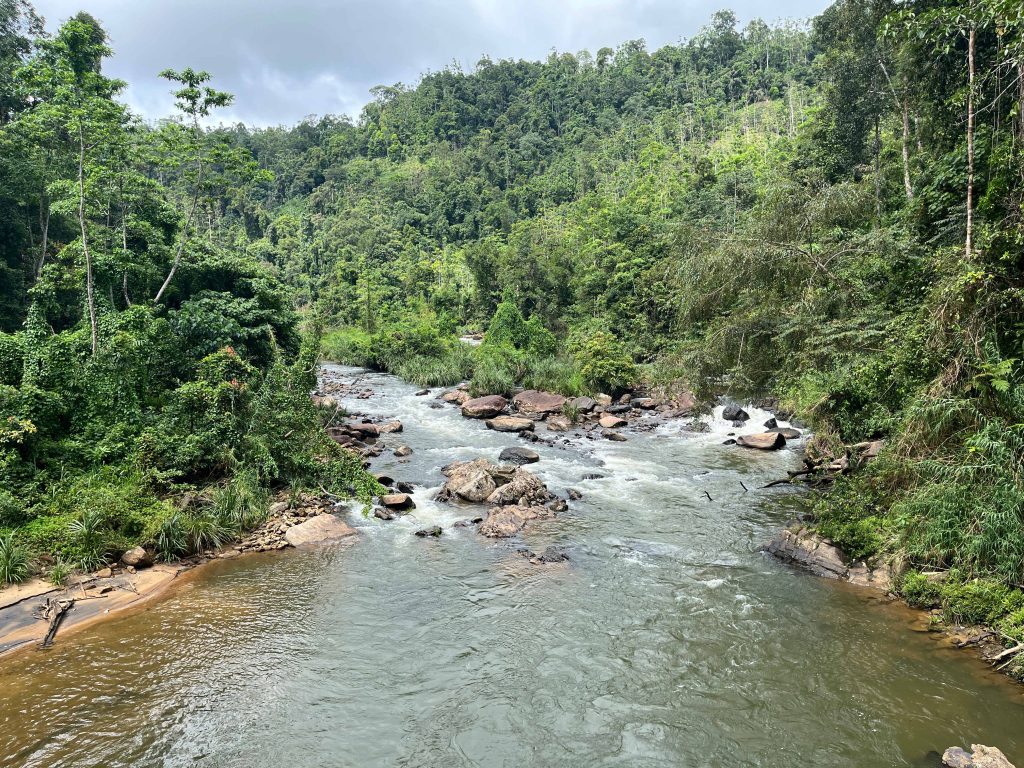
Sinharaja Forest Reserve is a UNESCO World Heritage Site in southwestern Sri Lanka, spanning the districts of Ratnapura, Galle, and Matara. To understand its true scale, three distinct area figures matter and most sources confuse them.
The UNESCO World Heritage core covers 8,864 hectares, comprising 6,092 ha of gazetted Forest Reserve and 2,772 ha of Proposed Forest Reserve. This is the figure most commonly cited online.
Beyond the World Heritage core, the Sinharaja National Heritage Wilderness Area was extended to 11,187 hectares, incorporating fragments of pristine habitat in the vicinity of the World Heritage Area that Sri Lanka recognised as ecologically inseparable from the core.
The full picture, however, is much larger. The complete Sinharaja forest complex, known as the Sinharaja Adaviya or Sinharaja Range encompasses 36,474.93 hectares of contiguous forest, including the surrounding satellite forests of the Rakwana Hills Massif. This full forest complex, not just the gazetted core, is what gives Sinharaja its true ecological significance.
It was declared a UNESCO Biosphere Reserve in 1978 and a World Heritage Site in 1988, the first natural site in Sri Lanka to receive that recognition. But statistics alone do not explain what you feel when you step inside.
What makes Sinharaja genuinely extraordinary is its endemism. More than 60% of its trees exist nowhere else on earth. Of Sri Lanka’s endemic animal species, over half make their home here. The forest ranges from around 100 metres to 1,385 metres in elevation, creating distinct ecological zones within a compact area. Annual rainfall between 3,600 mm and 5,000 mm sustains a level of humidity that keeps everything, the moss, the ferns, the fungi, the whole living fabric of the forest, in a state of perpetual growth.
When I bring visitors into Sinharaja for the first time, the thing that strikes them most is not a single dramatic animal encounter. It is the density of life. Everywhere you look, something is happening. That density is what I try to show people. Not a checklist, but a world.
The Birds — Why Sinharaja Is a Birdwatcher's Life List Destination
I am biased, I know. But I genuinely believe Sinharaja is one of the great birdwatching destinations on earth. Not just in Sri Lanka — on earth.
Of Sri Lanka’s 35 endemic bird species, 32 are present here. The full complement of rainforest endemics, in a single forest. No other location in the country gives you this concentration, and very few locations in Asia match it for endemic density.
The Mixed-Species Foraging Flocks
If you come to Sinharaja for birds, the mixed-species foraging flock is what you are really here for. These are extraordinary, dynamic assemblages of multiple species moving together through the forest canopy in a coordinated feeding movement that can involve anywhere from 15 to 48 species in a single encounter. They are invariably led by the Sri Lanka Drongo (Dicrurus lophorinus) and the Orange-billed Babbler (Argya rufescens). Both endemics whose calls draw and coordinate the other species around them.
When you encounter a full flock in motion, it is one of the most overwhelming wildlife experiences I know. Birds appear from every direction. The canopy comes alive. You cannot process it all fast enough. I have watched this happen thousands of times and it still stops me.
The key to finding flocks is knowing where to be and when. Early morning between 6:00 and 9:00 am is peak activity. An experienced guide who knows the specific trails and territories of the resident flock groups will get you there. Going in alone with a map will not.
Key Species to Know Before You Come
Sri Lanka Blue Magpie (Urocissa ornata) One of the most visually spectacular birds in Asia. Brilliant cobalt blue with rich chestnut wings, a reddish-brown head and neck, and a long graduated blue tail with a white tip. Both bill and legs are vivid red. Moves through the mid-canopy in small, vocal family groups. Most reliably and frequently encountered at the Kurulugala entrance where the transition zone between lowland and montane forest creates favourable conditions. Threatened globally and wholly dependent on intact forest. Sinharaja is its stronghold.
Green-billed Coucal (Centropus chlororhynchos) — Sri Lanka’s one of rarest endemic birds, and one of the most sought-after by visiting birdwatchers. A large, secretive cuckoo of dense forest interior. You will hear it more often than you see it — a deep, resonant call that carries through the understorey. Sinharaja is its last reliable stronghold on earth.
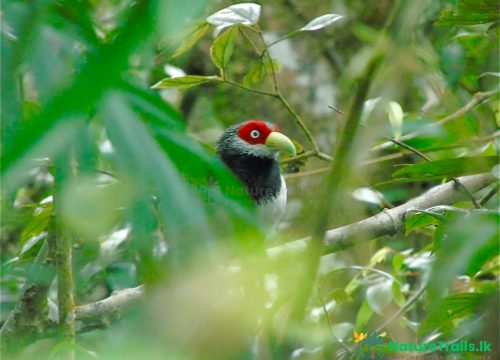
Red-faced Malkoha (Phaenicophaeus pyrrhocephalus) — A large, quietly spectacular cuckoo with a vivid crimson facial patch. Moves through dense vegetation with surprising stealth for its size. Always a genuine excitement when it appears.
Sri Lanka Drongo (Dicrurus lophorinus) The dominant flock leader. Glossy black, fork-tailed and supremely alert. Perches at the flock’s leading edge, scanning for aerial predators while the rest of the assemblage feeds below. Its harsh alarm call scatters the entire flock in seconds. Present year-round and active throughout the day wherever flocks are moving.
Orange-billed Babbler (Argya rufescens) The flock’s other anchor species. A warm brown, long-tailed babbler that moves noisily through the forest understorey in family groups of seven to ten or more. Watch for them driving insects through the leaf litter and low vegetation. Loud, social and almost always present when a flock is forming. Their chattering is often the first signal that a flock is nearby.
Ashy-headed Laughingthrush (Argya cinereifrons) A vocal, social endemic of the forest interior that moves in tight groups through the mid-level vegetation. Grey-hooded with warm brown upperparts, a buff throat patch and a beady pale eye. Its calling and movement often signals that a flock is forming or active nearby.
A full day of birdwatching in Sinharaja with an experienced guide regularly produces more than 50 species. Some dedicated birding days have exceeded that significantly.
[Explore Our Sinharaja Birding Tour] [Explore More About Endemic Birds]
Reptiles and Amphibians — The Part Most Visitors Overlook
I want to be honest with you about something. Most visitors come to Sinharaja for the birds. That is completely understandable. But in my nine years here, the aspect of this forest’s wildlife that has genuinely humbled me the most is its herpetofauna, its reptiles and amphibians.
The level of endemism in this group is staggering. We are talking about species that exist only here, on this island, often only in this specific forest or elevation zone. Some have ranges so small that a single road construction project could extinguish them. Understanding that while you are standing in the forest, knowing that the small frog calling from the stream beside you is found nowhere else on earth, changes the experience completely.
Snakes
Green Pit Viper (Trimeresurus trigonocephalus) — The snake most visitors encounter, usually coiled on a low branch over a stream at night. Brilliant emerald green, perfectly camouflaged against foliage in daylight. Venomous but not aggressive, the vast majority of encounters end with the snake simply watching you pass.
Hump-nosed Pit Viper (Hypnale hypnale) — Small, cryptically patterned, and easily overlooked on the forest floor. Medically significant in Sri Lanka due to its prevalence near human settlements. In the forest, it is a fascinating and beautiful animal that most people step past without ever knowing it was there.
Among the more specialist finds — the Aspidura species, small fossorial snakes of the forest floor litter layer, have produced some of the most significant field records in the Rakwana Hills area in recent years, with confirmed observations at Gongala and Morningside representing meaningful range extensions for certain species.
Lizards
Kangaroo Lizard (Otocryptis wiegmanni) — One of my favourite animals to show first-time visitors. A small, slender lizard of the forest floor that runs on its hind legs when alarmed, a genuinely startling and delightful thing to witness. Endemic and found throughout the lowland forest.
Hump-nosed Lizard (Lyriocephalus scutatus) — Strange, ancient-looking, and utterly distinctive. A slow-moving arboreal lizard with a bizarre nasal protrusion that makes it look like something from a different era of evolution entirely.
Amphibians
Sinharaja’s frog fauna deserves its own guide and eventually I will write one. The genus Pseudophilautus, Sri Lanka’s shrub frogs, is extraordinarily well-represented here across different elevation zones. Many species were described from specimens collected within a few kilometres of each other. Some remain incompletely described. When you hear the chorus of calls from a Sinharaja stream at night during the wet season, you are listening to one of the most endemic-dense amphibian assemblages anywhere on earth.
The Nannophrys ceylonensis — found exclusively on wet rock surfaces along fast-flowing streams, are among the most remarkable. The caecilians (Ichthyophis species), limbless burrowing amphibians that most visitors never encounter, represent one of the most evolutionarily ancient lineages in the forest.
For researchers and herpetologists: the Gongala and Morningside zone within the Rakwana Hills Massif has been particularly productive for significant field records in recent years. I strongly recommend consulting with a specialist guide before any research visit to this area.
Mammals — Patience Rewarded
Sinharaja is not a place where mammals walk out in front of you the way they might in an open savanna park. This is dense forest, and forest mammals are elusive by nature. But that elusiveness is part of what makes an encounter here feel earned.
Purple-faced Langur (Semnopithecus vetulus) — The forest’s most reliably encountered primate, and always a highlight. You often hear a troop before you see them. A crashing, whooping commotion moving through the upper canopy that announces their presence from some distance. The Southern Purple-faced Langur (S. v. vetulus), the subspecies found in Sinharaja, is critically endangered globally. Watching a family troop move through the canopy above you, knowing how precarious their situation is beyond this forest’s boundaries, is one of those moments that stays with you.
Toque Macaque (Macaca sinica) — Sri Lanka’s other endemic monkey, smaller and more terrestrial than the langur. Social, curious, and often encountered near forest edges.
Sri Lankan Leopard (Panthera pardus kotiya) — Present in Sinharaja and its buffer zones, but rarely seen. Any sighting is genuinely exceptional. What you are more likely to find are the signs, a pugmark in soft mud, a claw mark on a tree, the sudden alarm calls of the langur troop. Learning to read those signs is one of the most rewarding things I teach.
Sri Lankan Giant Squirrel (Ratufa macroura) — Spectacular and frequently encountered in the upper canopy near fruiting trees. The largest squirrel in Sri Lanka, with a striking black body and tail with a cream-coloured belly, unmistakable even at canopy height.
Fishing Cat (Prionailurus viverrinus) — Elusive, nocturnal, and associated with the forest streams. Rarely seen but genuinely present.
When to Come
Sinharaja receives rain throughout the year. That is not a warning. It is a description of what makes this place what it is. But if you want the most comfortable conditions for wildlife observation, timing matters.
December to March is the best period for most visitors. The northeastern monsoon has passed, trails are in good condition, and bird activity is at its peak. Mixed-species flocks are active and frequently encountered. This is when I recommend visiting if you have flexibility in your schedule.
July to August offers a secondary drier window, less reliable than December to March but generally productive. As the forest recovers from the southwestern monsoon, amphibian activity increases. This is an excellent period for anyone with a specific interest in frogs and reptiles.
April to June and October to November are the peak monsoon months. Trails are muddy, leeches are active, and conditions are challenging. I still guide during these periods, and for researchers focused on amphibians, the wet season can be extraordinary. But I am honest with general visitors about what to expect.
One important note: the Morningside and Gongala areas in the Rakwana Hills have a different rainfall pattern from the southern lowland entrances. Always ask your guide specifically about conditions in those areas before planning a visit.
Come With Someone Who Knows This Forest
Every visitor to Sinharaja must be accompanied by a licensed guide. That is a legal requirement. But beyond the regulation, in a forest of this complexity, a guide is simply essential. Not because the trails are dangerous, but because what you see without guidance and what you see with the right guidance are two completely different experiences.
I have spent nearly nine years learning this forest at a scientific level. I know where the flock territories are. I know which streams the Green Pit Vipers favour. I know the trails where the Frogmouth roosts. I know the elevation zones where you are likely to encounter species that most guides have never seen.
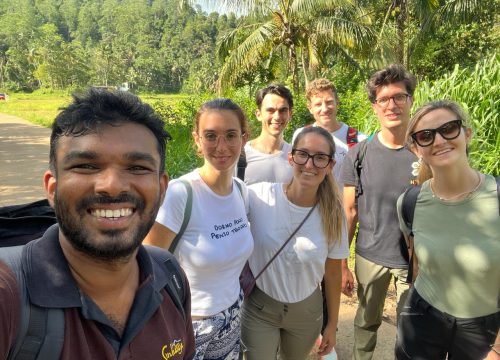
If you are serious about experiencing Sinharaja properly, whether you are a birdwatcher building your endemic checklist, a wildlife photographer, a researcher, or simply someone who wants to understand what they are looking at, I would be glad to take you there.