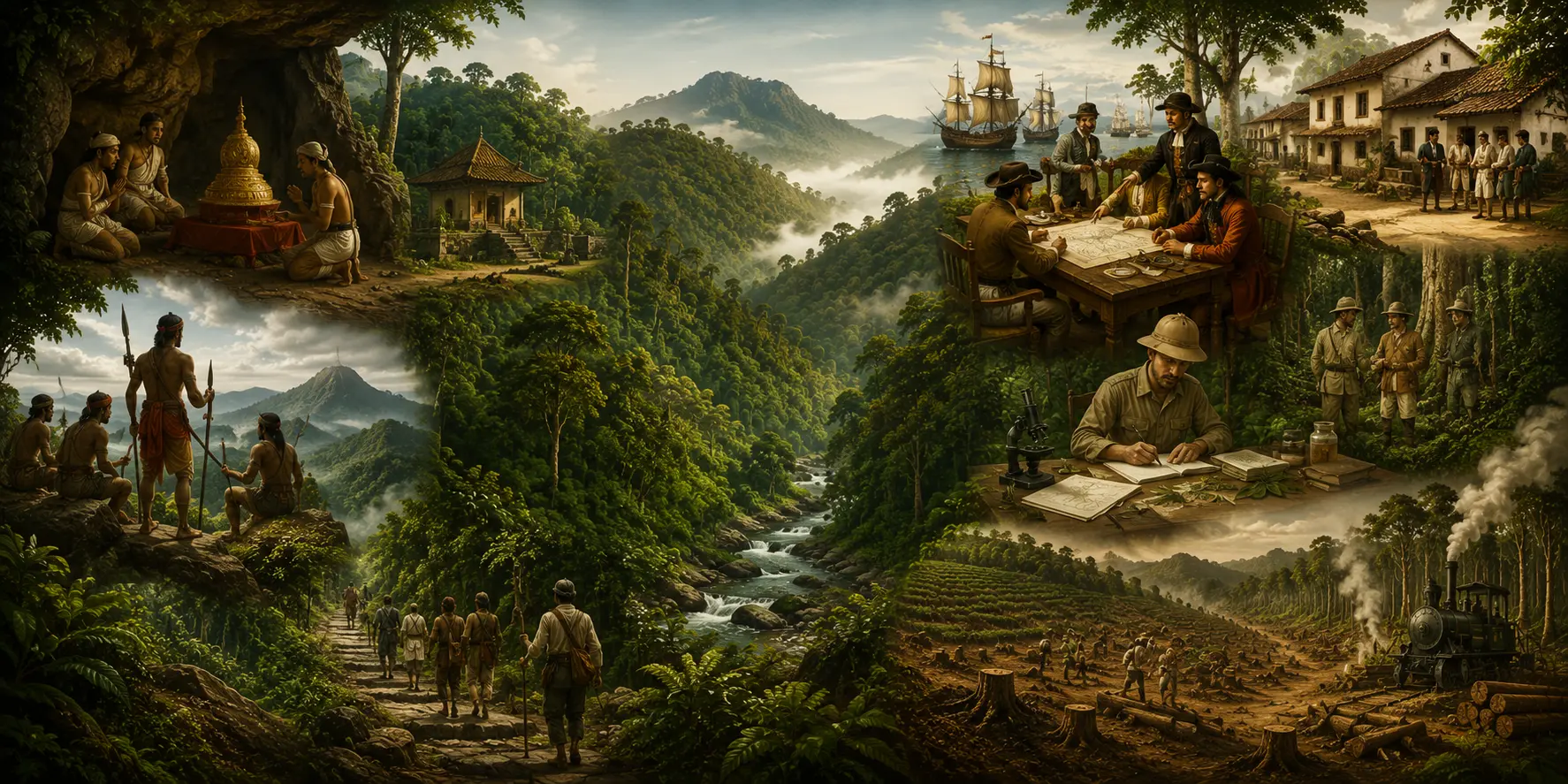
Studying the history of Sinharaja is essential for understanding and properly planning its conservation and development methodologies. Over different eras, conservation practices evolved based on political and scientific foundations. To properly grasp how the Sinharaja region was utilized and to build future conservation plans, looking back at its history is vital.
The Pristine Nature of the Forest
While historical records do not explicitly mention Sinharaja during early kingdoms, it is believed that because kingdoms did not migrate into this specific region and due to ancient laws enforced during those periods, Sinharaja remained an untouched, pristine wet evergreen rainforest until the colonial era. However, Sinharaja is frequently mentioned in various folklore, local traditions, and village histories surrounding the area.
Key Historical Events & Royal Connections
The text highlights several major historical events where the Sinharaja region served as a sanctuary, particularly for protecting the sacred Tooth Relic of the Buddha:
King Buwanekabahu (1271–1283 AD): During a time when various regional rulers followed different religions, a Sinhalese Buddhist group—led by Nilamess (officials)—brought the sacred Tooth Relic on the back of an elephant into the Sinharaja area for protection. They placed it inside a stone cave at a place called Pallekanda in the village of Kolonne. They protected and venerated the Tooth Relic there for five years.
Hathmala Ella Region: In addition to Pallekanda, the Tooth Relic was hidden and protected at a temple in the Hathmala Ella area. As a token of gratitude, a 1,500-acre land grant (Gamvarayak) from that area was offered to the Tooth Relic, which is said to belong to the Temple of the Tooth (Kandy Dalada Maligawa) even today.
King Vijayabahu I of Polonnaruwa (1055–1110 AD): According to the Panakaduwa Copper Plate (issued in the 27th year of his reign), a massive 9,900-acre land grant from the Morawak Korale, Panakaduwa area was offered to the Dalada Maligawa.
King Walagamba: It is also noted that when King Walagamba fled the capital, he traveled through the Malaya Rata (hill country) and arrived at the temple in Kolonne village within the Sinharaja area, where he stayed to protect the sacred Tooth Relic.
Folklore, Military History, and Ancient Paths
King Walagamba’s Rebellion (103 BC): Local folklore among Sinharaja villagers states that when King Walagamba fled to the mountainous regions following a South Indian invasion, he organized his army. Four generals from the Galle Korale traveled through the Kukulu Korale and stationed troops near the Sinharaja border to launch counter-attacks against enemies. The massive rock formation where they gathered is known today as Yodha Galgoda.
The Legend of the Last Lion: Another popular village folklore states that a giant named Lankanatha killed the last lion of Sri Lanka in this area, and the rock formation where he gathered is called Yodha Galgoda. The village where this giant lived is known as Lankagama.
Ancient Pilgrimage Routes: In the distant past, footpaths stretched from Galle Korale through Kukulu Korale and across Sinharaja’s mountain ridges all the way to Sri Pada (Adam’s Peak). Southern pilgrims traditionally utilized two distinct routes passing directly through Sinharaja to complete their pilgrimage.
Early Written Accounts and Foreign Travelers
Ibn Battuta (1347 AD)
The earliest written historical record of Sinharaja was made by the famous Moroccan explorer Ibn Battuta, who lived from 1304 to 1369. During his extensive travels across Asia between 1332 and 1347, he visited Sri Lanka around 1344 – 1345. In his travelogues, he explicitly notes that his journey to Sri Pada was made along a footpath running directly through the heart of the Sinharaja forest.
The Portuguese Era (1618 AD)
Ancient land registers known as Thombus provide early institutional records. In 1618, during the Portuguese rule, lands in local villages were registered to collect taxes. In these Sinhala Thombus, Sinharaja is formally referred to and recorded as “Floral”.
The Dutch Era (1656–1796 AD)
Following the Portuguese, the Dutch colonial administration controlled Sri Lanka’s maritime provinces. Between 1656 and 1796, they collected taxes from the villages surrounding Sinharaja. They map-mapped its boundaries, producing the very first formal boundary map of the forest in 1789.
The British Era and Agricultural Assessments (1874 AD)
Following British colonization, James West, a coffee planter, made specific references to Sinharaja in his 1874 reports. He noted in his writings that because of the specific soil layers found within the Sinharaja area, the land was entirely unsuitable for coffee cultivation.
Scientific Exploration and Early Conservation Records
The text details the rapid growth of botanical and zoological interest in the forest during the 19th and 20th centuries:
John R. Baker (1937): Published a report titled “The Sinharaja rain forest, Ceylon” in the Journal of the UK Royal Geographical and Science Society. He described Sinharaja as an untouched Virgin Forest spanning roughly 90 square miles (approximately 23,000 hectares).
Early Botanical Records (1849): G.H.K. Thwaites, the Director of the Peradeniya Botanical Gardens, documented numerous plant species from Sinharaja in his seminal work, Enumeratio Plantarum Zeylaniae.
Forestry & Wildlife Studies:
In 1880, Vincent Legge conducted extensive research on the birds of Sinharaja.
In 1896, Frederick Lewis studied the diverse plant life of the forest.
Further studies on Sinharaja were documented in reports by Mendis (1907) and John Baker (1936).
Renowned Sri Lankan scientist P.E.P. Deraniyagala conducted extensive zoological research on the animal species within Sinharaja.
In 1953, a researcher named de Rosayro compiled comprehensive reports on the unique flora of the forest.
Environmental Impact Note
According to historical reports, the massive clearing of the forest—which originally spanned roughly 40,000 hectares—began after 1840 due to the heavy commercial impacts of the British plantation culture (wathu sanskruthya), severely altering the ecosystems of the regions surrounding Sinharaja.