Amphibians of Sinharaja Rainforest
Very few visitors come to Sinharaja specifically for the amphibians. They come for the birds, or the snakes, or simply the forest itself. The amphibians find them.
A shrub frog the size of a thumbnail sitting motionless on a leaf at eye level. The sound of a corrugated water frog carrying above the noise of a fast stream, a call so similar to a bird whistle that most visitors never identify the source. A caecilian moving through wet leaf litter after heavy rain with a kind of purposeful efficiency that makes it look like something from a much older world. These are not dramatic encounters in the way a Green Pit Viper or a Sri Lanka Blue Magpie is dramatic. They are something quieter and in many ways more profound, a reminder that the most extraordinary biodiversity in this forest is not always the most visible.
I have watched guests who arrived indifferent to frogs spend an hour crouched beside a stream, completely absorbed, because something small and perfectly formed was doing something they had never seen before. That is what Sinharaja’s amphibians do to people who slow down enough to notice them.
The Toads
Common Indian Toad (Duttaphrynus melanostictus) is the most familiar amphibian in Sri Lanka, immediately recognisable by its robust warty body and large kidney-shaped parotid glands. Most people assume it belongs to the human-modified landscape and stops at the forest edge. I have found it deep inside the primary forest, far from any village, which tells something important about how ecologically flexible this species actually is. Primarily nocturnal but occasionally active during the day.
Kotagama’s Toad (Duttaphrynus kotagamai) is an Endangered endemic confined to lowland rainforest below 1,070 metres, known from Sinharaja among a small number of localities. Primarily nocturnal though it can be seen active on the forest floor by day under dense canopy. Distinguished from other Duttaphrynus species by a horseshoe-shaped inwardly curved black warty parietal ridge on the head.
Noellert’s Toad (Duttaphrynus noellerti) is a Critically Endangered endemic I have encountered personally in Sinharaja. Restricted to lowland rainforest from 60 to 460 metres, it is primarily nocturnal and also seen around stream banks with rocks and on the forest floor under dense canopy shade. Distinguished from Duttaphrynus melanostictus by elongated parotid glands and a smaller tympanum. The dorsum is reddish-ash or reddish-brown, heavily marbled with dark brown.
Kelaart’s Dwarf Toad (Adenomus kelaarti) is a Vulnerable endemic found in wet submontane and lowland forests below 1,500 metres. Unlike the Duttaphrynus toads it is slender and flat-bodied with smooth finger edges and no bony ridges on the head. It hides under boulders, rock crevices, decaying logs, tree holes, and leaf litter, and occasionally displays arboreal habits. I have found them on rocks away from streams, suggesting a broader microhabitat tolerance than the literature implies.
The Stream Specialists
Corrugated Water Frog (Lankanectes corrugatus) belongs to a subfamily, Lankanectinae, found only in Sri Lanka, and is one of only two species in the genus Lankanectes. What makes it genuinely remarkable is a set of features found in no other frog group in Sri Lanka. The lower jaw carries two fang-like tooth structures called odontoid processes, earning the genus the name Sri Lanka Fanged Frogs. Adults also retain a lateral line system, the sensory system more commonly associated with fish, making them exceptionally well adapted to aquatic life. The hindlimbs are fully webbed and the tympanum is indistinct. The skin is heavily wrinkled with transverse folds and the call is characteristic, similar to a bird whistle, heard both day and night. When disturbed it hides in loose mud at the bottom of the water body.
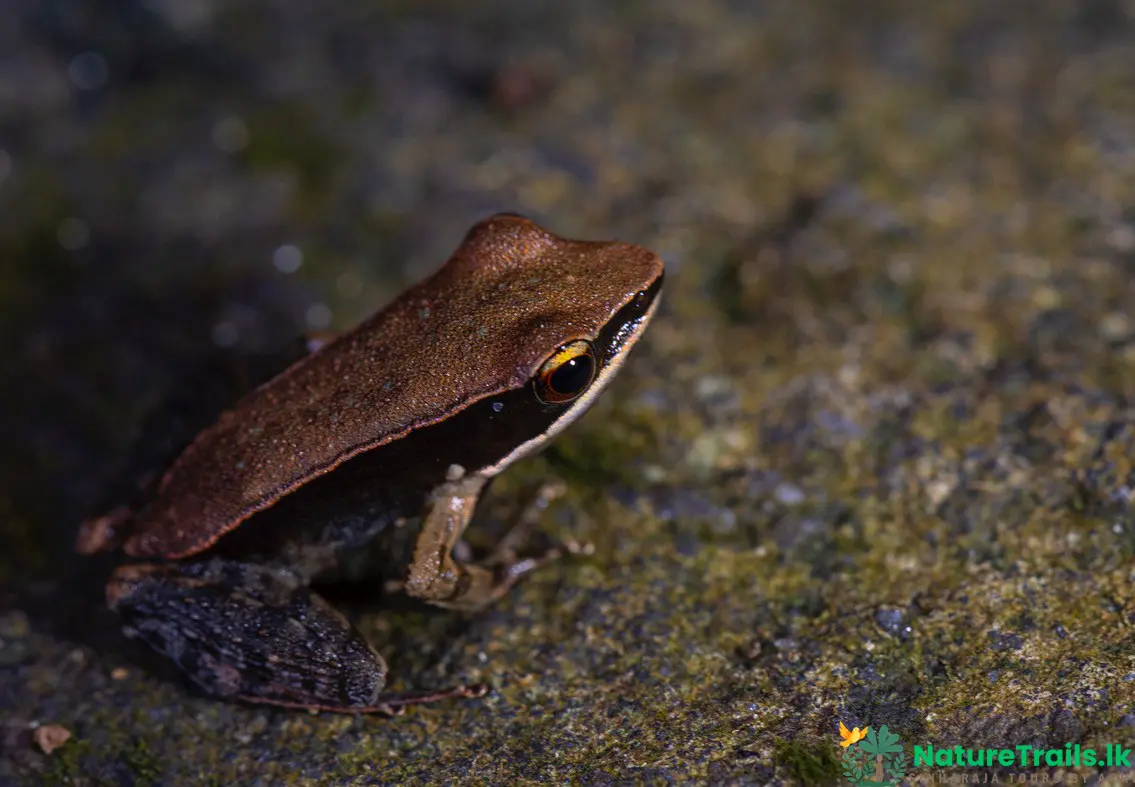
Sri Lanka Golden-backed Frog (Indosylvirana serendipi) is a Near Threatened endemic found in the lowland wet zone up to 1,000 metres, common in Sinharaja Rainforest. A nocturnal stream-associated species found on banks of streams and in marshy areas. Distinguished from Indosylvirana temporalis by smaller size, slender build, and absence of a supratympanic fold. The upper lip carries a gold to metallic-yellow stripe and the iris is reddish-brown with golden specks.
Günther’s Golden-backed Frog (Indosylvirana temporalis) is a Near Threatened endemic widely distributed in the wet zone from 60 to 1,830 metres. A medium to large stream-dwelling species commonly seen on boulders adjacent to streams and forest pools, active by day and night, and capable of climbing trees to some extent. Distinguished from Indosylvirana serendipi by larger size, robust build, and the presence of a supratympanic fold. The dorsal side is golden-brown and the upper lip is bright yellow or golden.
Sri Lanka Rock Frog (Nannophrys ceylonensis) is a Vulnerable endemic with a dorsoventrally flattened body, horizontal pupils, and blunt fingertips, all adaptations for life on wet rock surfaces near fast-moving streams. The flat body allows it to press into narrow rock crevices and under boulders along streams and cascades. Tadpoles are semi-terrestrial, capable of living on wet rock surfaces, and male frogs guard the eggs until they hatch. Restricted to the lowland wet zone up to 1,100 metres.
Sri Lanka Wood Frog (Hydrophylax gracilis) is an endemic found in wet, intermediate, and dry zones from 28 to 1,250 metres. It lives close to water sources on rocks and low vegetation and usually hides well in places that are very difficult to locate. Distinguished from Indosylvirana species by granular skin in the posterior abdomen, a thick well-developed dorsolateral fold, longitudinal stripes on the shanks, weakly developed digital discs, and a distinct whitish lateral glandular fold from the back of the mouth to the groin. Mainly calls between 7.30 PM and 10.30 PM.
Mountain Paddy Field Frog (Minervarya kirtisinghei) is a Near Threatened endemic associated with the margins of shaded shallow slow-flowing streams inside forest canopies. Encountered at higher elevation stream margins in Sinharaja . Primarily active during the day, found hopping through moist leaf litter or resting on muddy banks adjacent to streams. Many individuals carry a striking mid-vertebral stripe ranging from bright chestnut to pale yellow. The advertisement call is distinctly cricket-like.
The Narrow-mouthed Frogs
Brown Pug-snout Frog (Uperodon obscurus) is a Near Threatened endemic found in the lowland wet zone up to 1,200 metres. A small flat frog with a teardrop-shaped body and well-developed toe webbing. Hides by day under leaf litter, logs, and crevices and produces a sticky white offensive-smelling substance when handled. Breeds in water-filled tree holes and drains with egg clutches of 50 to 250 eggs floating on the water surface.
Nagao’s Pug-snout Frog (Uperodon nagaoi) is a Vulnerable endemic recorded from a small number of localities including Sinharaja Rainforest. Distinguished from Uperodon obscurus by rudimentary rather than well-developed toe webbing and by a dark purple and grey belly with white spots. Breeds almost exclusively in water-filled tree holes, depositing egg clutches hung inside the walls of tree holes a few centimetres above the water level, on tree trunks 30 centimetres to 9 metres above the ground.
Common Bull Frog (Uperodon taprobanicus) is not endemic to Sri Lanka, being distributed across Sri Lanka, India, and Nepal. A medium-sized globose frog familiar from gardens and village areas. It is included here because visitors staying near the forest will encounter it and knowing the difference between this widespread species and the rarer forest specialists is part of understanding the full amphibian community of the Sinharaja landscape.
Karunaratne’s Narrow-mouthed Frog (Microhyla karunaratnei) is a Critically Endangered endemic and the smallest amphibian on this page at 15 to 21mm. Restricted to wet forests and degraded habitats in the Rakwana Mountains at 500 to 1,100 metres. I have recorded this species in the Rakwana Hills system in areas near the Morningside sector of Sinharaja. Distinguished from all other Microhyla species in Sri Lanka by median clefts in the toe tips and a whitish belly with large black or brown blotches. Nocturnal, hiding by day under wet leaf litter and decaying logs.
The Tree Frogs
Common Hourglass Tree Frog (Polypedates cruciger) is a Least Concern endemic and one of the most commonly encountered tree frogs in and around Sinharaja. Medium to large, robust, with a characteristic hourglass-shaped marking on the dorsum and skin on the head co-ossified with the skull. Nocturnal and arboreal, common around human habitations as well as in the forest. Foam nests are deposited on surfaces above water so tadpoles fall in when they hatch. Its call is part of the nocturnal soundscape of Sinharaja.
Ranwella’s Spined Tree Frog (Polypedates ranwellai) is an Endangered endemic immediately distinguished from all other Sri Lankan Polypedates species by four dorsal spines on the back of the head and a protrusion at the proximal end of the jaw. The dorsum has very small black spots on a bright luminous yellow to brown or ashy-white background. Nocturnal and arboreal, perching on branches about 1.5 metres above the ground. Occurs in forests and forest edges of the lowland wet zone.
Long-snout Tree Frog (Taruga longinasus) is an Endangered endemic found in the wet zone from 150 to 1,000 metres, the more reliably encountered of the two Taruga species in Sinharaja on standard day tours. Immediately distinguished by an extremely elongated and pointed snout and a bright red band running from the tip of the snout to the middle of the flank. Usually found around well-shaded pools during the breeding season when 8 to 10 males gather and call from overhanging vegetation.
Morningside Saddled Tree Frog (Taruga fastigo) is a Critically Endangered endemic restricted to elevations above 1,000 metres in the Rakwana mountain range, known from Morningside and Kurulugala in Sinharaja. Nocturnal and arboreal, found close to water bodies at night with tadpoles developing in shallow stagnant pools with thick leaf litter substrate in heavily shaded forest. Distinguished from Taruga longinasus by the presence of an incomplete dark brown hourglass-shaped marking on the dorsum, red canthal ridge and supratympanic fold, and orange or yellow calcar and vent tubercles.
The Shrub Frogs — Pseudophilautus Species
The shrub frogs are where Sinharaja’s amphibian diversity becomes genuinely extraordinary. Sri Lanka’s Rhacophoridae is the most diverse frog family on the island with 83 species, 82 of which are endemic. The genus Pseudophilautus dominates this diversity and Sinharaja and the Rakwana Hills system hold a remarkable concentration of species spanning the full elevation gradient of the forest.
What makes the shrub frogs ecologically remarkable is their reproductive strategy. They complete their entire life cycle on land, bypassing the aquatic larval stage entirely, with fully formed froglets emerging directly from eggs laid in moist leaf litter or vegetation. This has allowed them to colonise every microhabitat from the forest floor to the canopy and to diversify into an extraordinary number of species occupying subtly different ecological niches in the same forest system.
Pseudophilautus stictomerus (Orange-canthal Shrub Frog) — Vulnerable endemic, 60 to 515m. Instantly identified by bright neon-orange stripes along the canthal edges, upper eyelid margins, and supratympanic folds against a dark brown dorsum with a pale yellow mid-dorsal stripe. Habitat generalist found in primary forest and disturbed habitats.
Pseudophilautus reticulatus (Reticulated Thigh Shrub Frog) — Endangered endemic, 30 to 900m. Medium-sized, distinguished by a reticulated pattern on the posteriors of the thighs and fully webbed toes. Active mostly at night, can be heard calling from tree tops 10 to 20 metres above ground. Known from Sinharaja Rainforest.
Pseudophilautus cuspis (Sharp-snouted Shrub Frog) — Endangered endemic, 150 to 1,100m. Distinguished by an exceptionally acute sharply pointed and protruding snout. Found only in closed canopy rainforests. Active by both day and night on leaf litter, low vegetation, moss-covered rocks, and tree trunks. Known from Sinharaja Rainforest.
Pseudophilautus fergusonianus (Ferguson’s Shrub Frog) — Least Concern endemic, 300 to 1,000m. A small flattened arboreal nocturnal species seen on wet moss-covered boulders in streams, tree trunks, and moist walls. The posterior sides of the lower arms and feet carry a distinctive row of white glandular tubercles. Known from Sinharaja Rainforest.
Pseudophilautus sordidus (Grubby Shrub Frog) — Endemic, Not Evaluated, 80 to 1,060m. Nocturnal, hides in rock crevices and fallen logs, occurs around streams in both closed and open canopy forests. The dorsum varies from chestnut to dark or ashy-brown with dark brown symmetrical patches. Known from Sinharaja Rainforest.
Pseudophilautus cavirostris (Hollow-snouted Shrub Frog) — Vulnerable endemic, 200 to 1,000m. A nocturnal species that perches on shrubs 0.3 to 2 metres above the ground and frequents branches, mossy logs, tree trunks, mossy rock surfaces, tree holes, and crevices close to streams. Merges well with its substrates. Known from Sinharaja Rainforest.
Pseudophilautus auratus (Golden Shrub Frog) — Endangered endemic, 510 to 1,270m. Characterised by a highly variable pale yellow to orangish-brown dorsum with dark brown spots. A fairly uncommon habitat specialist, males perch 1 to 1.5 metres above the ground on understorey shrubs calling mainly at night. Known from Sinharaja at Kudawa, Morningside, and Handapan Ella Plains.
Pseudophilautus silvaticus (Forest Shrub Frog) — Endangered endemic, 510 to 1,240m. Restricted to closed canopy rainforests and cardamom plantations in the Rakwana mountain range. Nocturnal, males call at night from low vegetation 30 centimetres to 1 metre above ground. The canthal edges are distinctively orangish-brown. Known from Morningside, Kurulugala, and Lankagama in Sinharaja.
Pseudophilautus procax (Cheeky Shrub Frog) — Least Concern endemic, above 1,000m. A habitat generalist found in forest edges, open and closed canopy forests, near streams and marshy areas, and cardamom plantations. Nocturnal, males perch and call from leaves 1 to 2 metres above ground level. Distinguished by a distinct yellow infraorbital patch and a dorsally concave head.
Pseudophilautus decoris (Elegant Shrub Frog) — Critically Endangered endemic, above 1,000m. Restricted to the Rakwana Mountains including Morningside and Kurulugala in Sinharaja. Found in leaf litter and low vegetation in thick canopy forest and cardamom plantations. Can be seen vocalizing while perched on leaf litter and low shrubs at dusk and during the night. Dorsum light grey-brown with a red-brown patch in the middle and two black bands extending from the upper flanks to mid-back.
Pseudophilautus lunatus (Handapan Ella Shrub Frog) — Critically Endangered endemic, above 1,000m. Restricted to the Rakwana Mountains. Nocturnal, occurring about 1 metre above ground level at night. Mid-dorsum reddish-brown with two dark brown bands. Flank pale ashy-brown with dark brown patches.
Pseudophilautus ocularis (Golden-eye Shrub Frog) — Critically Endangered endemic, above 1,000m. An arboreal species found on trees at night in closed canopy cloud forests and forest edges. Dorsum and lateral aspects changeable from light green to dark blackish-green with scattered black spots. The inguinal zone and thighs are distinctively bluish-green. Known from Morningside, Handapan Ella Plains, Gongala, and Kurulugala in Sinharaja.
Pseudophilautus papillosus (Papiliated Shrub Frog) — Endemic, Not Evaluated, above 1,000m. Known only from the Rakwana mountain range including Handapan Ella Plains and Morningside in Sinharaja. Found on branches about 2 metres above ground level. A medium-sized elongated frog with two short spines at the heels and fully webbed toes.
Pseudophilautus poppiae (Poppy’s Shrub Frog) — Critically Endangered endemic, above 1,000m. Restricted to the Rakwana mountain massif including Handapan Ella Plains, Morningside, and Kurulugala in Sinharaja. Nocturnal, seen on shrubs and trees. The dorsum is bright yellowish-green with black dots and some individuals have yellow or red spots. The inguinal zone and anterior thighs are brownish-yellow.
Pseudophilautus simba (Sinharaja Shrub Frog) — Critically Endangered endemic, above 1,000m. A very small ground-dwelling leaf litter species seen slowly crawling along the forest floor by day, unique among the Pseudophilautus species on this page in its diurnal ground-dwelling behaviour. Known from the Morningside area and Kurulugala in Sinharaja. The dorsum is light brown to chestnut-brown and the flanks are dark brown with white or light blue patches.
The Caecilians
Common Yellow-band Caecilian (Ichthyophis glutinosus) is a Vulnerable endemic and the most widespread caecilian in Sri Lanka, distributed in the wet zone from 150 to 1,400 metres. The largest of the two species in Sinharaja at 165 to 410mm total length, with 329 to 415 annuli and a vivid yellow lateral stripe running from head to tail on both sides of the body. The dorsum is purplish-brown or blackish-brown.
Lesser Yellow-banded Caecilian (Ichthyophis pseudangularis) is a Vulnerable endemic confined to the south-west wet zone from 250 to 1,200 metres, known from Kurulugala-Sinharaja and Deniyaya among other localities. Smaller than Ichthyophis glutinosus at 199 to 314mm with 269 to 304 annuli. Distinguished from Ichthyophis glutinosus by the lower annuli count and a yellow stripe that narrows or breaks around the neck region.
Both species are nocturnal, fossorial, and burrowing, moving on land at night for foraging and other activities. They live under moist decaying leaf litter, under decaying logs, boulders, and in cool damp humus. After heavy rain both species appear on the surface including in the garden areas surrounding the reserve. I have found both in the gardens near the forest boundary after significant rainfall. For guests staying near the forest boundary, a heavy rain event at night is worth treating as a caecilian opportunity. The gardens become a different kind of field site.
A Note on Amphibians of Sinharaja Rainforest as Ecological Indicators
Amphibians are the most sensitive indicators of forest health in any tropical system. Their permeable skin makes them the first organisms to register changes in water chemistry, humidity, and temperature. A forest that holds high amphibian diversity across multiple species and elevation zones is a forest where the hydrology is intact, the humidity gradient is functioning, and the leaf litter and stream communities are undisturbed.
Sinharaja’s amphibian diversity is not an accident. It is a direct measurement of what the forest is still doing correctly. Every shrub frog calling from a leaf in the understorey is evidence that this system is still whole.
Nine years in this forest have made me pay attention to that evidence more carefully than almost anything else.