The Last Great Rainforest of Sri Lanka
Sinharaja is Sri Lanka’s last viable lowland wet evergreen rainforest. Tucked into the southwestern corner of the island within the Rakwana Hills massif, it is one of the most biologically rich and ecologically intact forest ecosystems remaining in South Asia. For those who walk beneath its canopy, Sinharaja is not simply a forest. It is a living record of the island’s evolutionary history, a functioning system of extraordinary complexity that has persisted largely undisturbed for millions of years.
The name Sinharaja carries deep cultural weight. Translated from Sinhala, it means Lion King, a name that speaks to the reverence with which this landscape has been regarded across centuries of Sri Lankan history. That reverence is well founded. No other forest in Sri Lanka concentrates so many species found nowhere else on earth within such a defined and accessible area.
A World Heritage Landscape
In 1989, UNESCO inscribed Sinharaja as Sri Lanka’s first Natural World Heritage Site, recognising its outstanding universal value as a tropical rainforest ecosystem of global significance. This followed an earlier designation in 1978 as a UNESCO Man and the Biosphere Reserve, placing Sinharaja within an international network of landscapes managed for the long-term coexistence of biodiversity and human communities.
The core protected area covers 8,864 hectares of primary rainforest. A landmark gazette notification in 2019 consolidated the broader reserve system into a unified protected area of 36,474.93 hectares spanning the Matara, Ratnapura, Galle, and Kalutara districts. This consolidation brought together the core wilderness area, surrounding proposed reserves, and peripheral state forests into a single legally defined entity for the first time in the forest’s conservation history.
That legal journey was neither simple nor swift. Understanding how Sinharaja came to be protected, and how close it came to being lost entirely, is essential context for appreciating what the forest represents today.
A Forest Built Over Millions of Years
Sinharaja belongs to a category of forest known as tropical wet evergreen rainforest, characterised by high rainfall, year-round canopy closure, extraordinary structural complexity, and a level of biological diversity that places it among the most species-rich terrestrial ecosystems on the planet.
The forest floor receives filtered light through a layered canopy that rises in places to thirty metres and beyond. Beneath the main canopy, successive layers of sub-canopy trees, shrubs, herbaceous plants, ferns, mosses, and epiphytes fill every available ecological niche. Streams run cold and clear through the interior, draining the hills and feeding river systems that supply water to communities across the southern and southwestern lowlands. The forest is not simply a collection of species. It is a system, and every element within it is connected to every other.
This structural and biological complexity is the product of uninterrupted evolutionary time. Sri Lanka separated from the Indian subcontinent long enough ago for its species to diverge along independent evolutionary paths, producing a flora and fauna with a level of endemism that is exceptional even by tropical standards. Sinharaja sits at the heart of this endemic zone.
Wildlife of Sinharaja
Sinharaja is one of the finest wildlife destinations in Asia for anyone with a serious interest in natural history. Its significance lies not only in the number of species present but in the proportion of those species that are found nowhere else on earth.
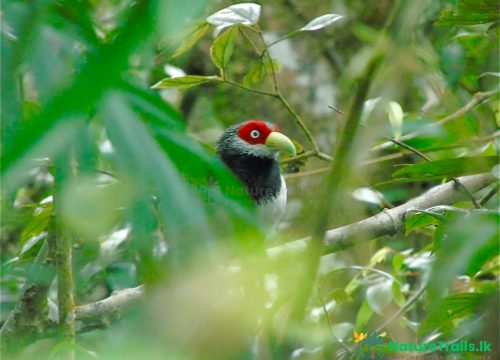
Birds: Sinharaja is renowned globally among birdwatchers for its endemic bird assemblage. The forest holds the great majority of Sri Lanka’s endemic bird species, many of which are most reliably encountered here than anywhere else on the island. The forest is particularly well known for its mixed-species feeding flocks, dynamic assemblages of multiple species that move together through the canopy in a phenomenon that rewards patient observation and rewards even more deeply when experienced with someone who knows how to read the forest.
Reptiles: The herpetofauna of Sinharaja represents one of the most diverse reptile assemblages in South Asia. The forest holds a remarkable concentration of endemic lizards, skinks, and snakes, many of them species described by science only in recent decades and still imperfectly known. Ground-level and canopy surveys consistently produce species of genuine scientific interest.
Amphibians: Sri Lanka has one of the highest amphibian endemism rates in the world, and Sinharaja is central to that story. The forest and its streams support a rich community of frogs, many of them restricted to specific elevation bands or microhabitats within the reserve. Several species remain poorly documented, and the forest continues to yield records of significance to researchers.
Mammals: While the forest’s mammals are less conspicuous than its birds or reptiles, patient observers encounter Purple-faced Langurs moving through the canopy, Giant Squirrels feeding in the upper storey, and the signs of Leopard, fishing cat, and other carnivores along forest trails. A single wild Asian Elephant also ranges within the broader reserve system.
Freshwater Life: The streams of Sinharaja support endemic freshwater fish and invertebrates adapted to the cool, oxygen-rich waters of the interior. These aquatic communities are an often-overlooked dimension of the forest’s biodiversity and one of considerable scientific importance.
For detailed species accounts drawn from field records within Sinharaja, the field guides on this site cover birds, reptiles, amphibians, and mammals in depth.
A Landscape with Deep Historical Roots
Sinharaja has been a presence in Sri Lankan life for as long as records exist. Ancient pilgrimage routes from the southern coast to Sri Pada (Adam’s Peak) passed directly through the forest. The Tooth Relic of the Buddha was sheltered within the Sinharaja area during periods of political instability. The Moroccan explorer Ibn Battuta recorded his passage through the forest in 1347. Portuguese colonial registers refer to it as Floreal in 1618. The Dutch produced the first formal boundary map of the forest in 1789.
Through centuries of kingdoms, invasions, colonial administrations, and independence, Sinharaja endured. It survived not because it was always well protected by law, but because its terrain was difficult, its soils unsuitable for certain crops, and because communities surrounding it maintained a relationship with the forest that persisted through political change.
The full story of how Sinharaja came to hold its current legal status, and how close it came to being lost to industrial logging and plantation agriculture, is documented in the History and Conservation sections of this site.
Experiencing Sinharaja
Sinharaja is a forest that rewards depth of engagement. A visit here is not a passive experience. The forest requires attention, patience, and a willingness to move slowly and observe carefully. Those who bring those qualities find themselves in the presence of wildlife encounters that are genuinely rare anywhere in the world.
The forest has multiple entry points, each with its own character and wildlife profile. The trails range from accessible lowland paths to demanding ridge walks that reach into the upper elevation zones of the massif. Stream crossings, canopy gaps, and the edges of secondary growth each create distinct conditions that support different species assemblages.
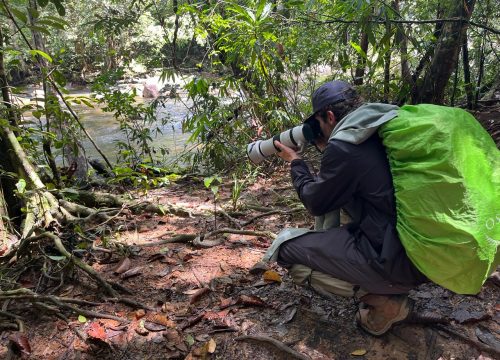
Sinharaja is most fully experienced with a guide who knows not just the trails but the forest itself. The difference between walking through Sinharaja and understanding what you are walking through is the difference a knowledgeable guide makes. Knowing where a mixed-species flock is likely to be at a given time of day, recognising the call of a bird before it comes into view, knowing which stream section to check for a particular frog species at a particular season, these are not skills that come from a single visit. They come from years of consistent field time in one place.
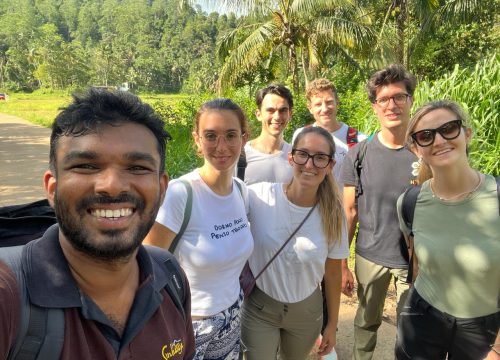
Our Sinharaja tours are designed around that depth of knowledge. Whether your primary interest is birdwatching, herping, general wildlife, or simply spending time in one of the world’s great rainforests, we offer private guided experiences built around what you want to see and how you want to move through the forest.
Sinharaja is a living system. Every visit contributes to its story. We invite you to be part of it.